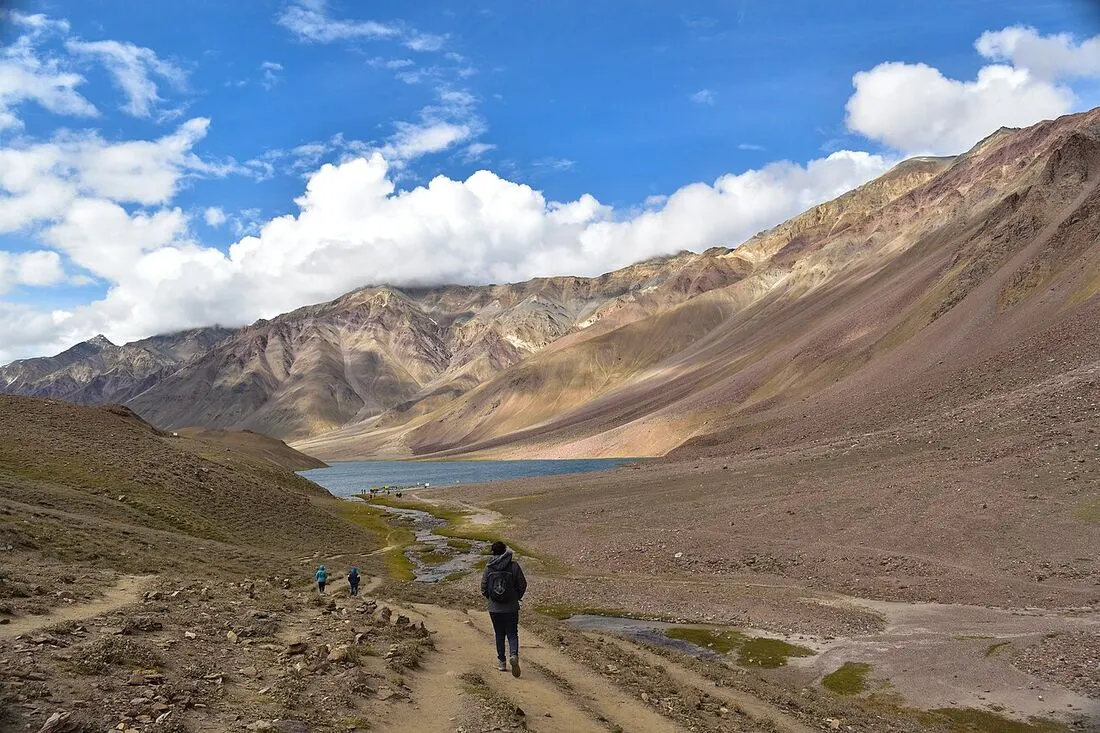
Photo: Adarsh Patel / Wikimedia Commons (CC BY-SA 4.0)
📋 In This Article
The Ganga — rising at the Gangotri Glacier at 3,892m in the Garhwal Himalayas and flowing 2,525km to the Bay of Bengal — is simultaneously India's most sacred river, the lifeline of its most densely populated plains, the home of unique and endangered aquatic species, and one of its most severely polluted waterways. Understanding the Ganga is to understand India itself.
The Ganga's Sacred Geography
For 800 million Hindus, the Ganga is a goddess (Ganga Mata) and the most purifying force in existence — a dip in the river is believed to wash away accumulated karma. The river's sacred geography spans its entire length: Gangotri and Gaumukh (the source, pilgrimage point), Devprayag (confluence of Alaknanda and Bhagirathi to form the Ganga), Rishikesh (yoga capital, gateway to char dham pilgrimages), Haridwar (Har Ki Pauri ghat, the most sacred bathing point), Allahabad/Prayagraj (Triveni Sangam — confluence of Ganga, Yamuna, and mythical Saraswati), Varanasi (where dying on the Ganga banks achieves moksha), and Ganga Sagar (where the river meets the sea on Makar Sankranti).
- Gangotri Glacier — source at 3,892m, shrinking 22m/year
- Haridwar — largest mass bathing event (Kumbh Mela 2021: 3+ million)
- Varanasi — oldest continuously inhabited city on Earth
- Ganga Sagar — confluence with Bay of Bengal, January pilgrimage
Ecology and Endemic Species
Despite severe pollution, the Ganga basin hosts extraordinary biodiversity. The Gangetic River Dolphin (India's national aquatic animal, fewer than 3,500 remaining) navigates by echolocation in the turbid river. Gharial (Gavialis gangeticus — the fish-eating crocodilian, critically endangered, fewer than 250 remaining) survives in the Chambal and Ken river tributaries. Hilsa fish (Tenualosa ilisha), an iconic and culturally significant fish, migrates from the sea to spawn in the upper Ganga. Over 140 fish species inhabit the Ganga ecosystem. The Ganga River Dolphin Sanctuary between Bijnor and Narora is the primary conservation zone.
Pollution and the Namami Gange Mission
The Ganga is critically polluted — 1.35 billion litres of sewage from 118 towns, industrial effluents from tanneries, textile mills, and chemical plants, and religious waste from cremations and immersions flow into the river daily. The Namami Gange programme (2014, budget ₹20,000 crore) aims to construct sewage treatment infrastructure, prevent industrial discharge, and restore riverbanks. Progress has been made in reducing industrial discharge; sewage treatment capacity has grown; dolphin populations show stabilisation. But the scale of the challenge — 450 million people in the Ganga basin — means full restoration is a generation-long project.
Experiencing the Ganga
Best experiences: Ganga Aarti at Haridwar (Har Ki Pauri) or Varanasi (Dashashwamedh Ghat) at dusk — a daily ritual of lamp offerings to the river of extraordinary beauty and atmosphere. White-water rafting on the Rishikesh section (Class III-IV rapids) in October-November and February-May. Boat ride at dawn in Varanasi past the ghats with cremations, yoga, and bathers — one of the world's most intense and moving experiences. Kayaking expeditions the length of the river are available from specialist adventure operators.
Conclusion
The Ganga is not just a river — it is a civilisation. Understanding and experiencing it is to encounter 5,000 years of human relationship with a living waterway: sacred, practical, exploited, and now slowly being restored. The effort to save the Ganga is, ultimately, an effort to save India's relationship with nature itself.