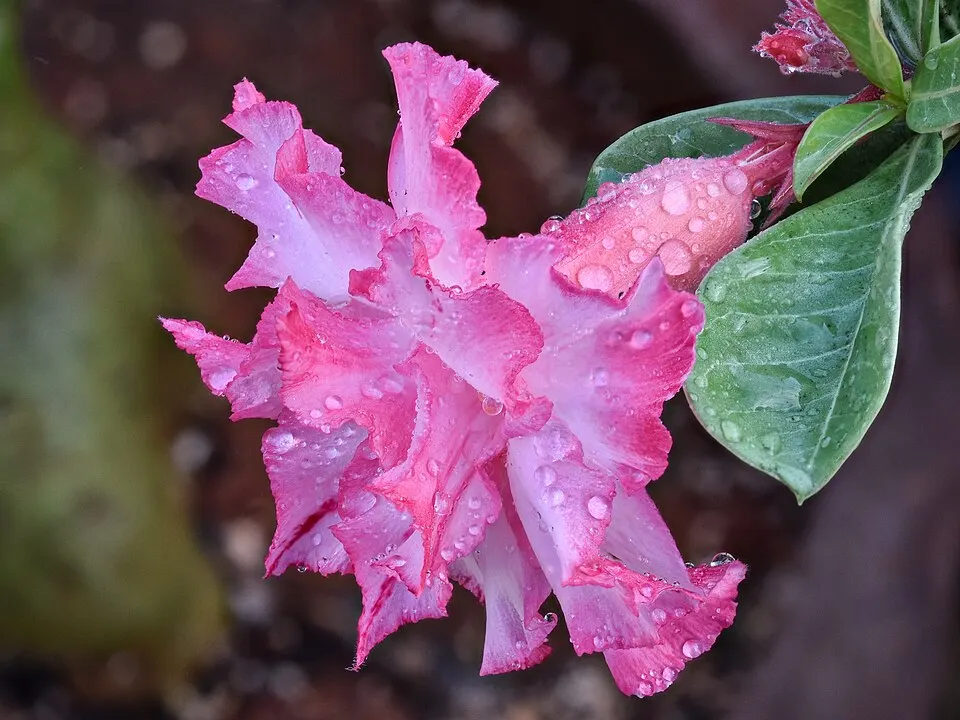
Photo: This Photo was taken by Timothy A. Gonsalves. Feel free to use my photos, but please mention me as the author. I would much appreciate if you send me an email tagooty@yahoo.com or write on my talk page, for my information. Please contact me before commercial use. Please do not upload an edited image here without consulting me. I would like to make corrections only at my own source to ensure that the changes improve the image and are preserved.Otherwise you may upload an edited image with a new name. Please use one of the templates derivative or extract. / Wikimedia Commons (CC BY-SA 4.0)
Adenium (Desert Rose) (Adenium obesum): Sculptural succulent shrub with stunning rose-like blooms — ideal for Indian climate gardens and pots.
🔍 Quick Facts
| Common name | Adenium (Desert Rose) |
| Other names | Adenium, Desert rose (no traditional Indian name) |
| Scientific name | Adenium obesum |
| Plant family | Apocynaceae |
| Size | 0.5–3 m succulent shrub |
| Native region | Africa, Arabian Peninsula |
| Climate | Arid/Tropical |
| Ease of growing | Moderate |
| Parts used | Flowers, Stem (display) |
About Adenium
Adenium stores water in a swollen trunk called a caudex, which collectors shape into bonsai-like forms. It flowers best in the hot, dry Indian summer and is one of the most popular collector plants in India, with hundreds of grafted colour varieties. It is grown purely as an ornamental — its sap is toxic and has historically been used as an arrow poison in Africa.
Botanically known as Adenium obesum, it belongs to the Apocynaceae family. It is native to Africa, Arabian Peninsula and grows best in a arid/tropical climate. The parts most often used are the flowers and stem (display).
Uses in the Garden & Tradition
Adenium is best known for:
- Ornamental
- Drought resistance
- Container gardening
- Bonsai form
- Terrace display
How It Is Used
- Grown as an ornamental, bonsai and collector plant.
- Caudex is exposed and shaped for display.
How to Grow Adenium
| ☀️ Sunlight | Full sun, 6–8 hours. |
| 💧 Watering | Water only when the soil is fully dry; almost none in winter and during heavy rain. |
| 🪴 Soil | Very gritty, fast-draining mix of sand, perlite and a little compost. |
| 🌱 Propagation | Seeds for a fat caudex; grafting for flower colour. |
| 📅 When to plant (India) | Repot in February–March; flowers March–June. |
| 🏡 In pots / at home | Ideal for shallow, wide pots. Protect from monsoon waterlogging. |
Precautions & Safety
- All parts, especially the sap, are toxic — keep away from children and pets.
- Wear gloves when pruning; wash hands afterwards.
Frequently Asked Questions
Written by the WhyOnPlanet editorial team · Last updated October 2026