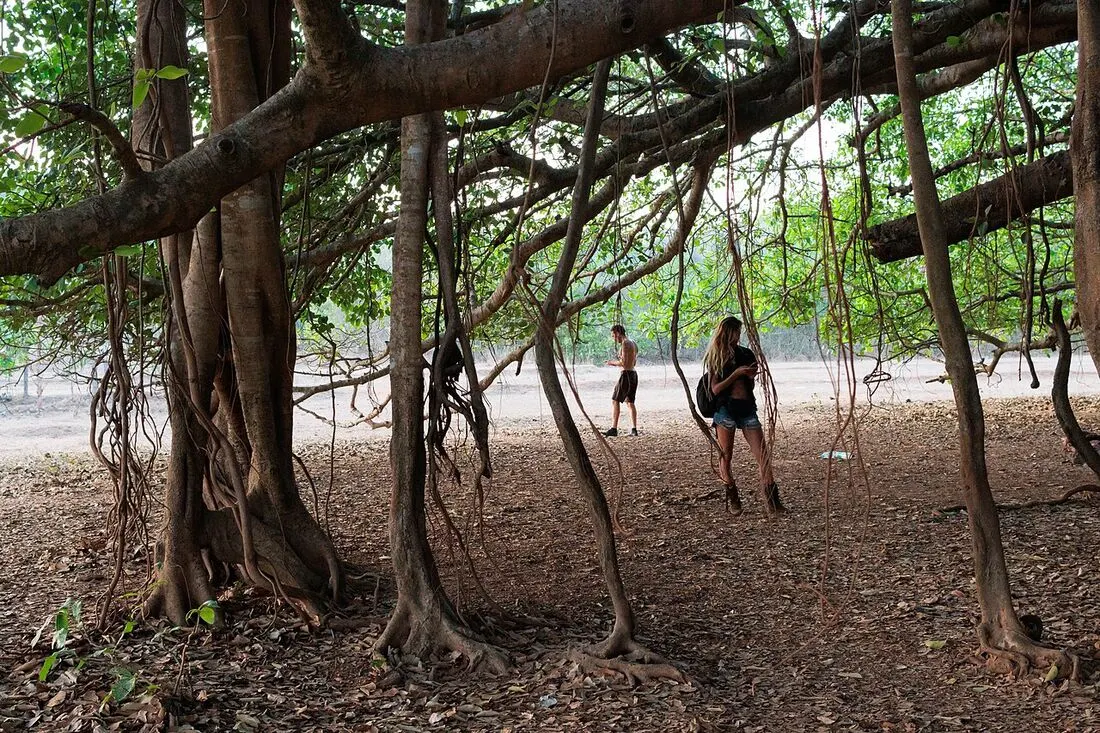
Photo: Vyacheslav Argenberg / Wikimedia Commons (CC BY 4.0)
📋 In This Article
The Khasi and Jaintia tribes of Meghalaya have maintained sacred forest groves (Law Lyngdoh or Law Kyntang) since ancient times — protecting them from all human extraction as the dwelling places of forest deities. These sacred groves, found in clusters throughout the Khasi Hills, are among the most biodiverse forest fragments in Northeast India and preserve plant species that have disappeared from surrounding areas.
The Mawphlang Sacred Grove
The Mawphlang Sacred Grove — 75 hectares, 25km from Shillong — is the most accessible and most visited of Meghalaya's sacred forests. Managed by the Law Lyngdoh (the traditional guardian priesthood), Mawphlang has been protected for at least 200 years with no extraction of any plant, tree, or animal permitted. The result: a forest of extraordinary density and diversity, with trees of 1-2m diameter, 25-30m canopy, multi-layered understory, and mosses, lichens, and orchids on every surface. The contrast with the surrounding degraded hillsides is dramatic and immediate.
- 75 hectares, strictly protected for 200+ years
- No extraction permitted — not even a leaf or stone
- 25km from Shillong on NH6
- Law Lyngdoh (traditional priests) manage the grove
Biodiversity of Meghalaya's Sacred Groves
Studies of Meghalaya's sacred groves have documented: over 400 plant species including 10 endemic orchids, 26 species of trees found nowhere else in Meghalaya outside sacred groves, 80+ lichens, and 55 fern species. The sacred groves function as biodiversity refugia — maintaining populations of plants and animals that have been eliminated from the surrounding landscape by centuries of agriculture and extraction. Some sacred groves protect traditional medicinal plant species that local Khasi healers (Nongkynmaw) depend on — plants disappearing from cultivated landscapes.
The Law Lyngdoh System
The Law Lyngdoh are the traditional community priests who hold authority over Khasi sacred groves. They conduct entry ceremonies, mediate disputes over grove boundaries, and enforce the prohibition on extraction. Violations are believed to attract divine punishment — the strongest possible deterrent. Visitors to Mawphlang Sacred Grove must be accompanied by a Law Lyngdoh or authorised guide; extraction of any material, even a stone, is strictly prohibited. The system has maintained the grove through colonial rule, Independence, and the pressures of modern development.
Sacred Grove Surveys and Recognition
The G.B. Pant National Institute of Himalayan Environment has surveyed over 79 sacred groves in Meghalaya, with total area estimated at 9,000+ hectares. The Forest Survey of India has mapped them as a distinct land use category. Several have been formally recognised under the Community Forest Management provisions of the Forest Rights Act 2006. International organisations including IUCN, UNESCO, and WWF have studied Meghalaya's sacred groves as models of community-based conservation for application in other countries.
Conclusion
Meghalaya's sacred groves are one of humanity's oldest operating nature reserves — maintained by faith, community authority, and accumulated ecological wisdom across generations. In an age of expensive conservation mechanisms and technical biodiversity management, these groves demonstrate that cultural and spiritual values, properly maintained, are conservation's most durable foundation.