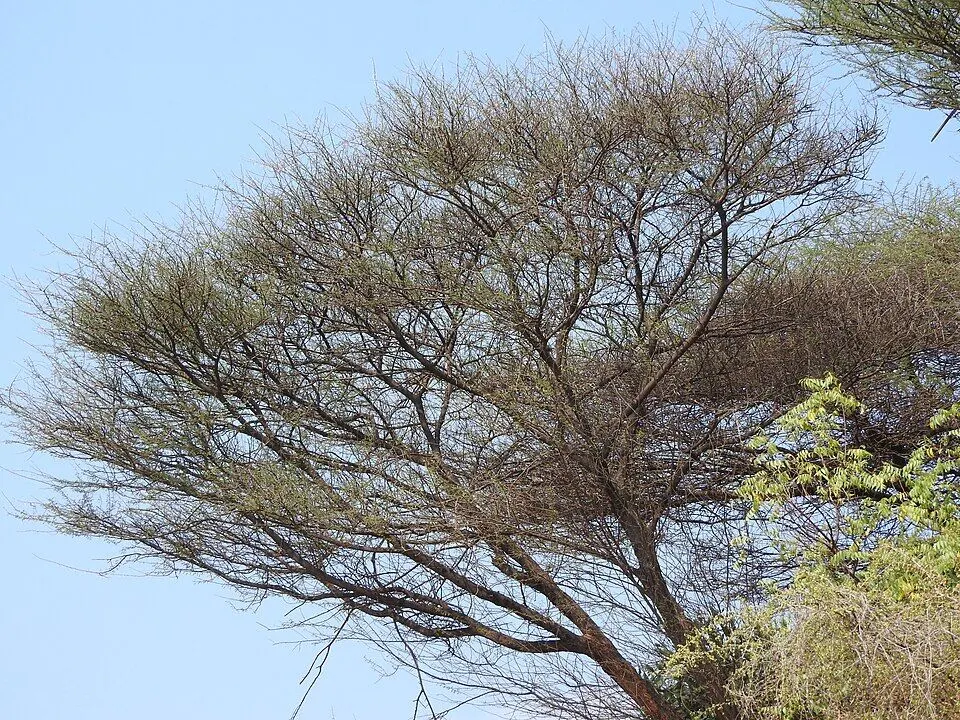
Photo: Yercaud-elango / Wikimedia Commons (CC BY-SA 4.0)
Acacia (Babool) (Acacia nilotica): Hardy drought-resistant tree providing timber, gum arabic, tannin, and traditional dental care.
🔍 Quick Facts
| Common name | Acacia (Babool) |
| Other names | Babool, Kikar (Hindi); Karuvelam (Tamil); Nalla tumma (Telugu) |
| Scientific name | Acacia nilotica |
| Plant family | Fabaceae (legume family) |
| Size | 5–20 m thorny tree |
| Native region | Africa, South Asia |
| Climate | Arid/Semi-arid |
| Ease of growing | Fast |
| Parts used | Wood, Bark, Gum, Pods |
About Acacia
Babool is a tough, thorny tree of India's dry regions, with yellow ball-shaped flowers and long white thorns. Babool twigs (datun) are, like neem, used as traditional toothbrushes, and its gum (gond) is used in laddoos for new mothers. Its bark is rich in tannins used for leather. (Note: the scientific name is now often given as Vachellia nilotica.)
Botanically known as Acacia nilotica, it belongs to the Fabaceae family. It is native to Africa, South Asia and grows best in a arid/semi-arid climate. The parts most often used are the wood, bark, gum and pods.
Timber & Economic Uses
Acacia is best known for:
- Timber
- Gum arabic
- Dental sticks (twigs)
- Tannin
- Fodder
What the Wood Is Used For
- Twigs are chewed as a natural toothbrush (datun).
- Gum (gond) is used in gond laddoos and for food and medicine.
- Hard timber for tools, carts and firewood; pods and leaves as fodder.
How to Grow Acacia
| ☀️ Sunlight | Full sun. |
| 💧 Watering | Very low; extremely drought tolerant. |
| 🪴 Soil | Grows in poor, saline and alkaline soils. |
| 🌱 Propagation | Seeds (soaked in hot water to soften the hard coat). |
| 📅 When to plant (India) | Plant in the monsoon. |
| 🏡 In pots / at home | Not suitable for pots. |
Precautions & Safety
- Sharp thorns.
- Can become invasive in some grasslands.
Frequently Asked Questions
Further Reading on Acacia
Written by the WhyOnPlanet editorial team · Last updated October 2026