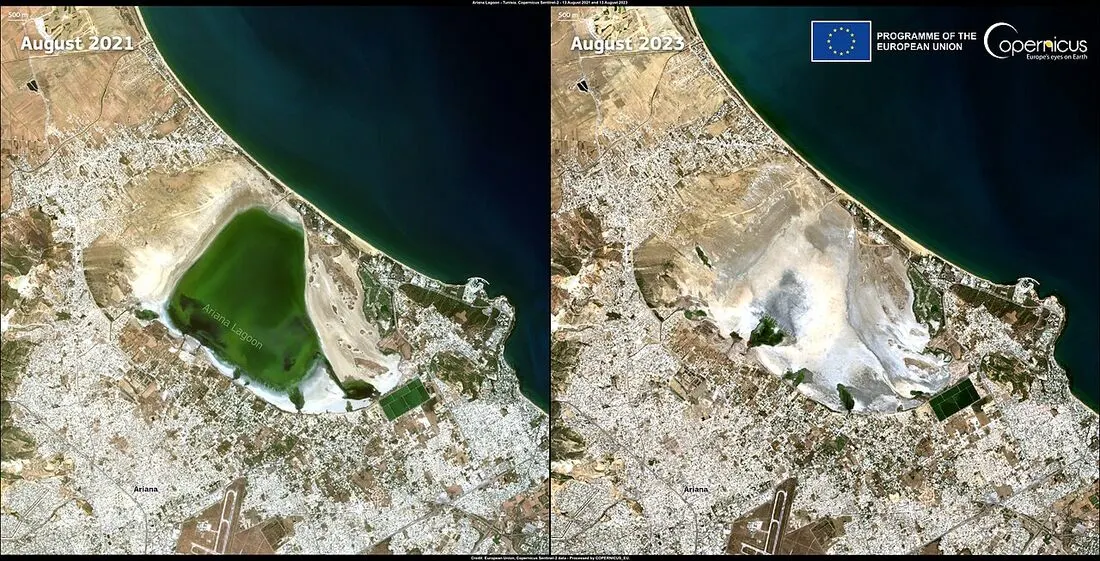
Photo: European Union, Copernicus Sentinel-2 imagery / Wikimedia Commons (Attribution)
📋 In This Article
India feeds 1.4 billion people from an agricultural system already under stress from water scarcity, soil degradation, and market volatility. Climate change adds a powerful new stressor that threatens to undermine decades of food security progress.
How Temperature Affects Crop Yields
Every 1°C of warming above optimal growing temperature reduces wheat yields by 6%, rice by 3–8%, and maize by 7%. India's average temperatures are projected to rise 2–4°C by 2100. Without adaptation, this could reduce India's food production capacity by 10–25%.
Water Stress and Irrigation
70% of India's irrigation relies on groundwater, which is being extracted faster than it recharges. Climate-driven monsoon variability makes surface water sources less reliable. Several Indian states — Punjab, Haryana, Rajasthan — are facing a groundwater crisis that will peak within 20 years.
Climate-Resilient Farming Practices
Solutions exist and are already being adopted.
- Drought-tolerant rice and wheat varieties (developed by ICAR)
- System of Rice Intensification (SRI) — 50% less water, 20–30% higher yield
- Zero-tillage wheat — saves energy, retains soil moisture
- Drip irrigation — 40–60% more efficient than flood irrigation
- Crop diversification — reducing dependence on water-intensive rice-wheat cycle
Food Price Volatility
Climate-induced crop failures drive food price spikes that hit the poor hardest — Indian households spend 45–55% of income on food. Stabilising food prices requires building strategic reserves, diversifying food production geography, and reducing post-harvest losses (currently 15–20% of India's crop production).
Conclusion
Food security is climate security. Investing in climate-resilient agriculture, water conservation, and soil health is not just environmental policy — it is the most important economic security investment India can make.