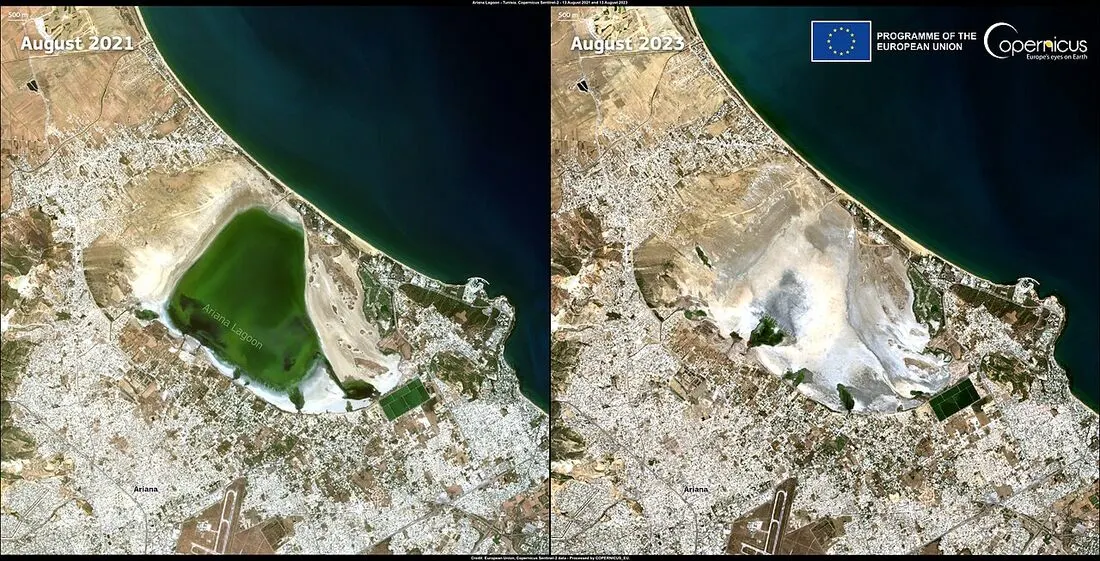
Photo: European Union, Copernicus Sentinel-2 imagery / Wikimedia Commons (Attribution)
📋 In This Article
India has a 7,500 km coastline home to 250 million people. Rising sea levels — currently increasing at 3.3mm per year globally — threaten to displace communities, flood farmland, and permanently inundate low-lying areas within decades.
How Much Have Sea Levels Risen?
Global mean sea level has risen approximately 20 cm since 1900, with the rate accelerating. The IPCC projects a further 30–60 cm rise by 2100 under moderate emissions scenarios, and up to 1 metre under high emissions. For India's flat coastal areas, even 50 cm is catastrophic.
Most Vulnerable Indian Coastlines
The Sundarbans delta in West Bengal, the coast of Odisha, parts of Kerala's backwaters, and low-lying areas of Tamil Nadu and Andhra Pradesh are most at risk. Mumbai's Bandra and Colaba areas, and Kochi's Vypin Island, face serious flooding threats.
- Sundarbans — already losing islands to sea
- Mumbai — Bandra, Dharavi at flood risk
- Odisha coastline — frequent cyclone-intensified flooding
- Kerala backwaters — salinity intrusion threatening rice fields
Impacts on Ecosystems and Agriculture
Saltwater intrusion destroys freshwater aquifers and agricultural land. Mangrove forests — which protect coasts and support fisheries — are being inundated faster than they can migrate inland. Coral reefs face bleaching from warmer, more acidic water.
Adaptation Strategies
India is investing in sea walls, mangrove restoration, and early warning systems. Coastal communities are being trained in disaster preparedness. Managed retreat — systematically relocating communities away from highest-risk areas — is being discussed but faces enormous social and political challenges.
Conclusion
Rising sea levels are not a distant future problem — they are reshaping India's coastlines today. Protecting coastal ecosystems like mangroves is one of the most cost-effective defences available.