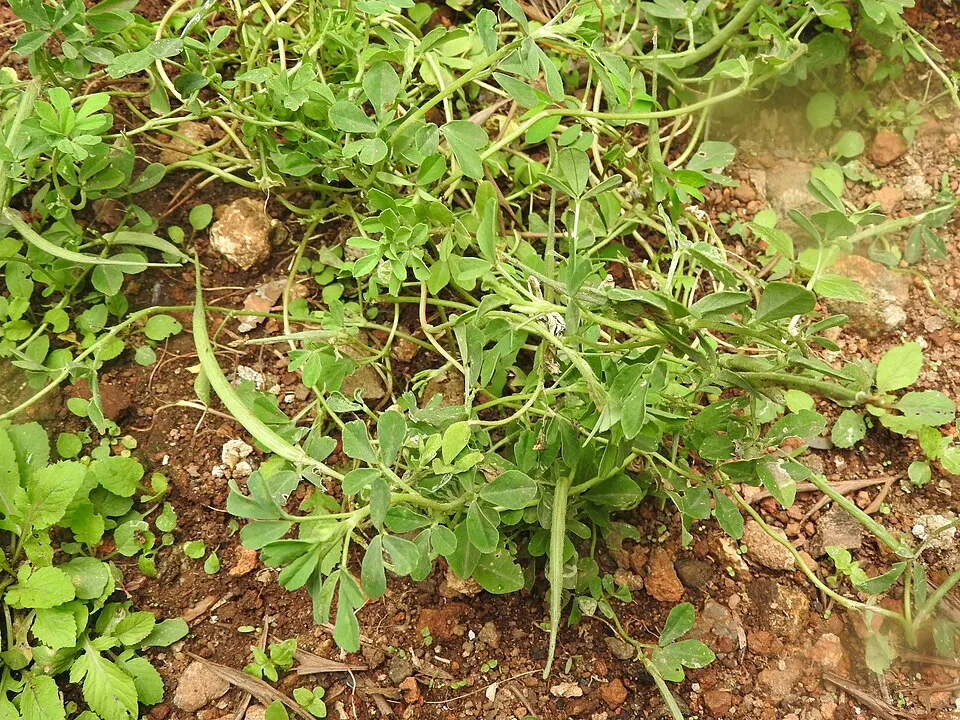
Photo: Yercaud-elango / Wikimedia Commons (CC BY-SA 4.0)
Fenugreek (Methi) (Trigonella foenum-graecum): Bitter seed and leafy herb that regulates blood sugar, aids lactation, and improves digestion.
🔍 Quick Facts
| Common name | Fenugreek (Methi) |
| Other names | Methi (Hindi, Marathi, Gujarati); Vendhayam (Tamil); Menthulu (Telugu) |
| Scientific name | Trigonella foenum-graecum |
| Plant family | Fabaceae (legume family) |
| Size | 30–60 cm annual |
| Native region | Mediterranean, South Asia |
| Climate | Semi-arid |
| Ease of growing | Easy |
| Parts used | Seeds, Leaves |
About Fenugreek
Fenugreek is grown in India both as a leafy green (methi saag) and for its hard, bitter golden seeds. India produces most of the world's fenugreek, mainly in Rajasthan and Gujarat. The seeds are rich in soluble fibre (galactomannan), which slows sugar absorption — the basis of its traditional use for blood sugar. It is also one of the fastest crops to grow at home: leaves are ready to harvest in about three weeks.
Botanically known as Trigonella foenum-graecum, it belongs to the Fabaceae family. It is native to Mediterranean, South Asia and grows best in a semi-arid climate. The parts most often used are the seeds and leaves.
Traditional & Ayurvedic Uses
Fenugreek is best known for:
- Blood sugar control
- Lactation support
- Digestion
- Hair growth
- Cholesterol
Most of these uses come from Ayurveda and folk medicine. Where we know of good clinical evidence, or of a specific safety concern, we say so in the overview, precautions and FAQs on this page.
How Fenugreek Is Used
- Leaves are cooked as methi saag, methi paratha, thepla and aloo methi.
- Seeds are tempered in oil for dals and pickles, or soaked overnight and eaten.
- Seed paste is applied to hair as a traditional conditioning mask.
How to Grow Fenugreek
| ☀️ Sunlight | Full sun to light shade. |
| 💧 Watering | Light, regular watering; avoid waterlogging, which rots the seedlings. |
| 🪴 Soil | Loose, well-drained soil; it fixes its own nitrogen, so little fertiliser is needed. |
| 🌱 Propagation | Direct-sow seeds (soaked overnight) 1 cm deep. They sprout in 3–5 days. |
| 📅 When to plant (India) | Best sown October–February. Summer sowing bolts quickly to seed. |
| 🏡 In pots / at home | Any shallow tray or pot 6 inches deep works. Sow a new batch every 2–3 weeks. |
Precautions & Safety
- Can lower blood sugar — combine with diabetes medication only under supervision.
- Avoid medicinal doses in pregnancy; it can stimulate uterine contractions.
- May cause gas and a maple-like body odour; people allergic to peanuts or chickpeas may react to it.
Frequently Asked Questions
Further Reading on Fenugreek
Written by the WhyOnPlanet editorial team · Last updated October 2026