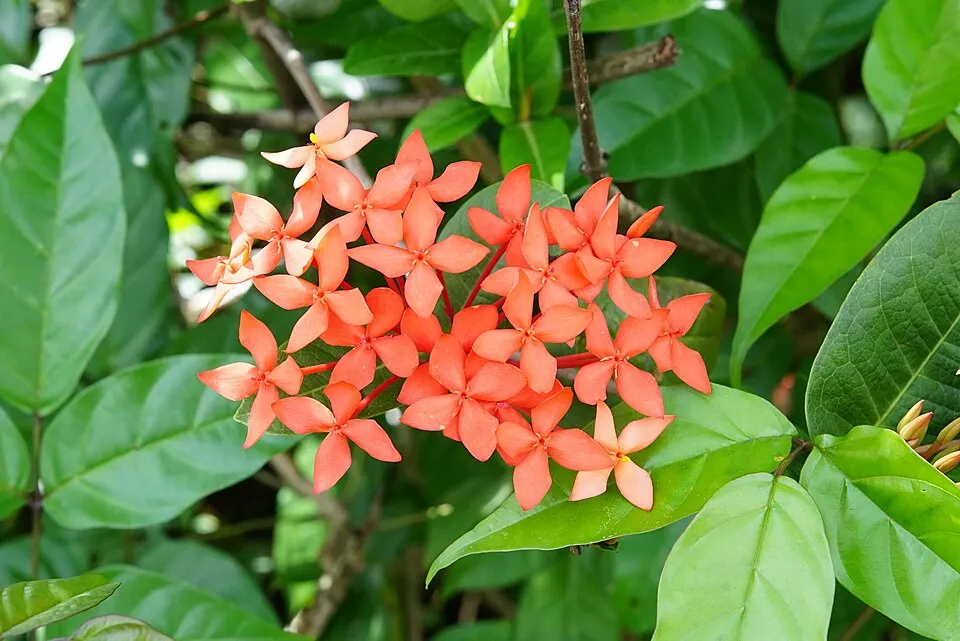
Photo: Vengolis / Wikimedia Commons (CC BY-SA 4.0)
Ixora (Jungle Flame) (Ixora coccinea): Ornamental shrub used in Ayurveda for skin diseases, wound healing, and fever management.
🔍 Quick Facts
| Common name | Ixora (Jungle Flame) |
| Other names | Rugmini, Rangan (Hindi); Vedchi (Marathi); Idlipoo, Thetchi (Tamil) |
| Scientific name | Ixora coccinea |
| Plant family | Rubiaceae (coffee family) |
| Size | 1–2 m compact shrub |
| Native region | South Asia, Southeast Asia |
| Climate | Tropical |
| Ease of growing | Moderate |
| Parts used | Flowers, Leaves, Roots, Bark |
About Ixora
Ixora produces dense, ball-shaped clusters of small four-petalled flowers in red, orange, pink or yellow for most of the year. It is a favourite hedge plant across South India and is offered in temples, which is why one of its names, "Jungle Geranium", is less used locally than "Thetchi". Dwarf varieties suit pots, while the taller red Ixora coccinea is the one used in traditional medicine.
Botanically known as Ixora coccinea, it belongs to the Rubiaceae family. It is native to South Asia, Southeast Asia and grows best in a tropical climate. The parts most often used are the flowers, leaves, roots and bark.
Traditional & Ayurvedic Uses
Ixora is best known for:
- Wound healing
- Skin diseases
- Fever
- Diarrhoea
- Antioxidant
Most of these uses come from Ayurveda and folk medicine. Where we know of good clinical evidence, or of a specific safety concern, we say so in the overview, precautions and FAQs on this page.
How Ixora Is Used
- Flower and root decoctions are used in folk medicine for diarrhoea and fever.
- Leaf paste is applied to minor wounds and skin sores.
- Flowers are strung into garlands and temple offerings.
How to Grow Ixora
| ☀️ Sunlight | Full sun to light shade; more sun means more flowers. |
| 💧 Watering | Regular watering; keep slightly moist. |
| 🪴 Soil | Acidic soil (pH 5–6). In alkaline soil leaves turn yellow — feed with sulphur or iron chelate. |
| 🌱 Propagation | Semi-hardwood cuttings with rooting hormone during the monsoon. |
| 📅 When to plant (India) | Plant June–September. |
| 🏡 In pots / at home | Excellent for 10–14 inch pots. Prune after flowering to keep it dense. |
Precautions & Safety
- Medicinal use is mostly traditional with little clinical data.
- Yellowing leaves usually mean alkaline soil, not disease.
Frequently Asked Questions
Further Reading on Ixora
Written by the WhyOnPlanet editorial team · Last updated October 2026