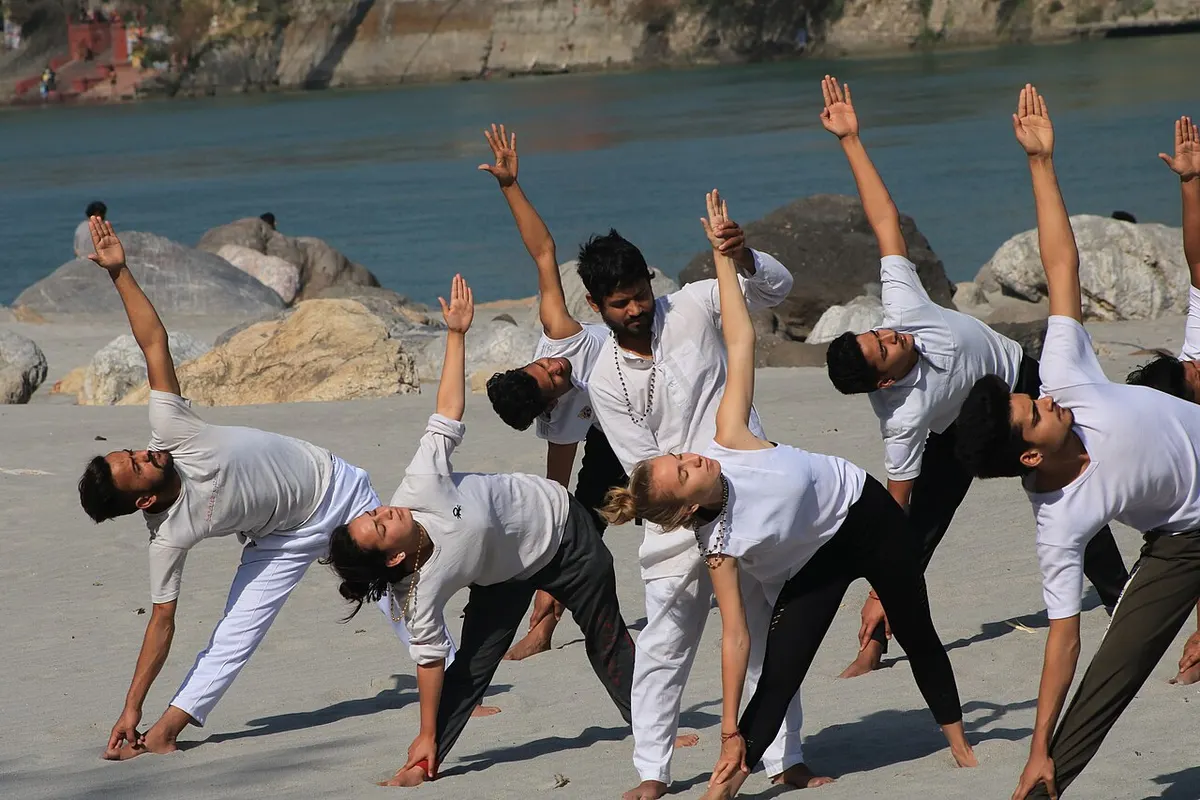
Photo: YogaTTC75 / Wikimedia Commons (CC BY-SA 4.0)
📋 In This Article
Sitting for 8-10 hours daily compresses lumbar discs, shortens hip flexors, weakens glutes, and tightens the thoracic spine — creating the biomechanical conditions for chronic lower back pain. Over 80% of desk workers experience back pain. The good news: a targeted 20-minute yoga practice can reverse these effects within weeks.
Understanding Desk Worker Anatomy
Prolonged sitting creates specific patterns: hip flexor tightness (psoas, iliacus) that tilts the pelvis forward creating lumbar hyperlordosis; weak glutes and hamstrings unable to support the pelvis; rounded thoracic spine from hunching over screens; forward head posture adding 20-30 lbs of compressive load on cervical vertebrae; and disengaged core muscles unable to provide spinal support. Yoga for desk workers specifically targets these patterns.
Hip Flexor Release Poses
Low Lunge (Anjaneyasana) is the most effective pose for hip flexor lengthening: step right foot forward between hands, lower left knee, sink hips forward until a deep pull is felt in the front of the left hip. Hold 8-10 breaths. Pigeon Pose (Kapotasana) provides deep external hip rotation and releases piriformis tightness (often the cause of "sciatica-like" pain). Reclined Figure-Four (Supta Kapotasana) is the accessible alternative for those with knee sensitivity.
- Anjaneyasana — Low Lunge, 8 breaths each side
- Kapotasana — Pigeon, 10+ breaths each side
- Supta Kapotasana — Reclined Figure-Four
- Prasarita Padottanasana — Wide-leg forward fold
Spinal Decompression and Strength
Supine Spinal Twist (Supta Matsyendrasana) creates lateral spinal traction and rotational mobility in the thoracic and lumbar spine — releasing the compression of sitting. Bridge Pose (Setu Bandha Sarvangasana) strengthens glutes, hamstrings, and spinal extensors while opening the hip flexors passively. Cat-Cow (10 slow rounds) restores spinal segmental mobility and increases synovial fluid circulation in intervertebral discs. Sphinx Pose provides gentle lumbar extension counteracting the flexed sitting position.
The 10-Minute Desk Worker Sequence
Morning (before sitting): Cat-Cow 10 rounds, Low Lunge 5 breaths each side, Bridge Pose 10 breaths. During work: Standing forward fold (hang for 60 seconds) every 90 minutes. Evening: Pigeon or Figure-Four 10 breaths each side, Supine Twist 10 breaths each side, Legs-Up-the-Wall 5 minutes. This 10-minute practice consistently addresses all the biomechanical problems created by desk work. Results within 4-6 weeks of daily practice.
Conclusion
Back pain from desk work is not inevitable — it is the predictable result of biomechanical neglect. These poses address the specific patterns created by prolonged sitting. The key is consistency (daily) and addressing hip flexors and glutes — the two most neglected areas in most gym and fitness programs.