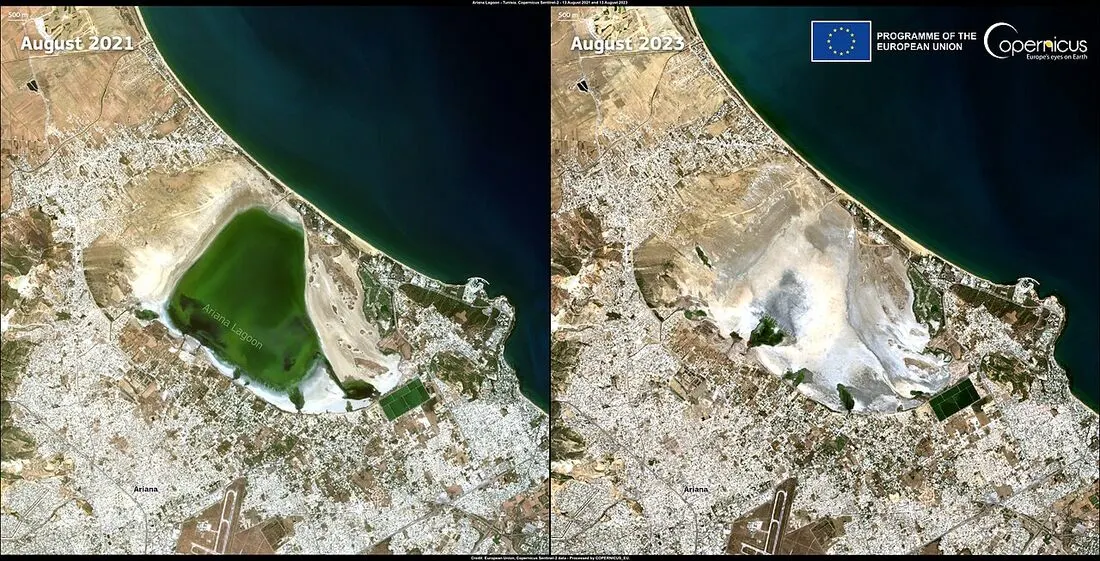
Photo: European Union, Copernicus Sentinel-2 imagery / Wikimedia Commons (Attribution)
📋 In This Article
India extracts more groundwater than any other country on Earth — 250 billion cubic metres per year. Combined with climate-driven monsoon variability, this unsustainable extraction is rapidly depleting aquifers that took thousands of years to fill.
The Scale of Depletion
NASA satellite data shows India's groundwater declining at 4 cm per year in the Indo-Gangetic Plain — the most productive agricultural region. Punjab and Haryana have seen water tables drop 1–3 metres per year in some districts. At current rates, many North Indian aquifers will be functionally depleted within 20–25 years.
Agriculture's Role
80% of India's groundwater is used for irrigation — primarily for water-intensive rice and sugarcane in regions not naturally suited to these crops. The Minimum Support Price system for rice has incentivised farmers in Punjab and Haryana to grow paddy despite scarce water. Policy change is essential alongside individual farmer adaptation.
Climate Change Amplifying the Crisis
Erratic monsoons reduce groundwater recharge. More intense but shorter rainfall events overwhelm infiltration capacity — water runs off rather than soaking in. Rising temperatures increase evapotranspiration, requiring more irrigation. The combination is accelerating aquifer depletion faster than models predicted.
Solutions: From Traditional to High-Tech
Reviving traditional water harvesting (johads, baolis, check dams) recharges local aquifers. Drip irrigation reduces agricultural water use by 40–60%. Watershed management across entire catchment areas increases recharge. Treating and reusing urban wastewater for agriculture frees freshwater for other uses.
Conclusion
India's groundwater crisis is a slow-moving emergency that requires urgent policy reform, agricultural transformation, and mass public awareness. The solutions exist — what is lacking is the urgency the crisis deserves.