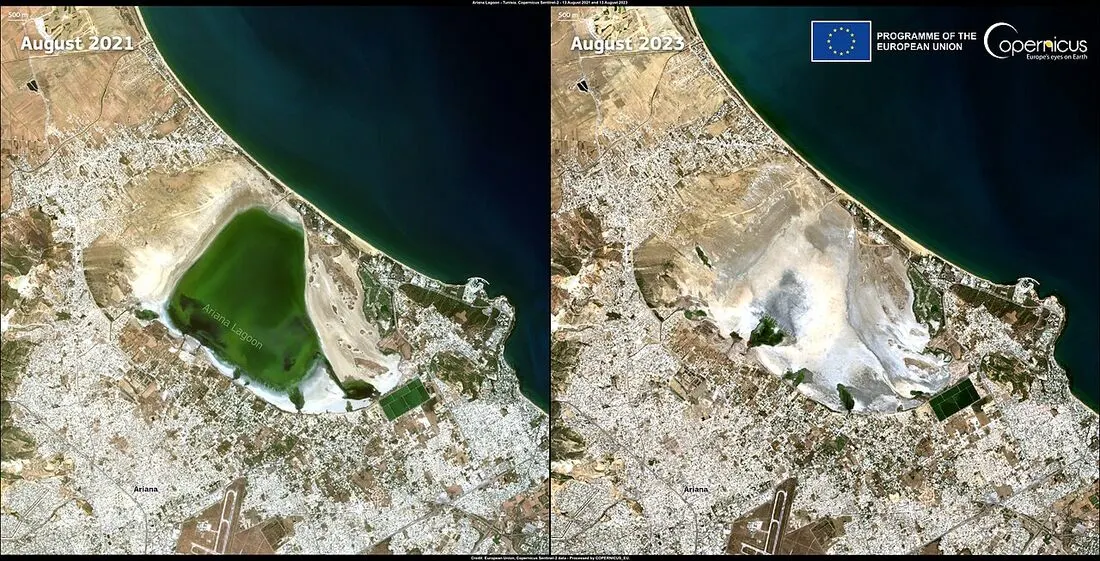
Photo: European Union, Copernicus Sentinel-2 imagery / Wikimedia Commons (Attribution)
📋 In This Article
While atmospheric CO₂ traps heat, oceans absorb 30% of human CO₂ emissions — a service that slows climate change but at a devastating cost to marine ecosystems. Ocean pH has dropped by 0.1 units since the Industrial Revolution, representing a 30% increase in acidity.
The Chemistry of Ocean Acidification
When CO₂ dissolves in seawater, it forms carbonic acid, which reduces pH and the availability of carbonate ions — the building blocks of shells and coral skeletons. At current emission rates, ocean pH is projected to drop a further 0.3–0.4 units by 2100, unprecedented in the past 65 million years.
Impacts on Marine Ecosystems
Coral reefs — which support 25% of all marine species — are doubly stressed by warmer water (bleaching) and acidification (reduced calcification). India's Lakshadweep, Gulf of Mannar, and Andaman coral reefs are already showing significant bleaching and structural weakness.
- Coral bleaching and death
- Oysters and shellfish unable to form shells
- Disruption of fish larvae development
- Loss of reef structure that protects coastlines
- Reduced biodiversity across marine food chains
Impact on Indian Fisheries
12 million Indian fishers depend on marine ecosystems for their livelihoods. Ocean acidification and warming are shifting fish distribution patterns, reducing shellfish harvests, and degrading the reef ecosystems that serve as fish nurseries. The Bay of Bengal and Arabian Sea are both warming 3× faster than the global ocean average.
What Can Protect Our Oceans
Reducing CO₂ emissions is the only long-term solution. Short-term measures include protecting and restoring seagrass meadows and mangroves that buffer local acidity, reducing coastal pollution and runoff, creating marine protected areas, and developing aquaculture techniques adapted to higher-acidity conditions.
Conclusion
Ocean acidification is the invisible companion to climate change — largely unseen but with enormous consequences for biodiversity, food security, and coastal protection. Protecting our oceans starts with reducing emissions.